The Bagel, the Queue, and the Cost of Desire
London Bagel Museum and the Uncomfortable Future of Korea's Emotional Retail
There was a time, not long ago, when the line outside London Bagel Museum looked like the purest evidence of success. In Seoul, where taste often travels first through photographs, the queue became part of the product. To stand in it was not merely to wait for bread. It was to participate in a small urban ritual: a pilgrimage to a bakery that was not really British, not really a museum, and not entirely about bagels.
It was, instead, a perfectly calibrated fantasy.
Inside, the brand offered a Seoulite version of London: antique-looking fixtures, warm lighting, storybook clutter, photogenic paper bags, coordinated uniforms, and bagels that seemed to have wandered away from New York orthodoxy into the softer, sweeter, more theatrical world of Korean café culture. The genius of London Bagel Museum was never that it imported authenticity. It was that it manufactured atmosphere.
In 2026, however, the same brand has become harder to consume innocently. London Bagel Museum is still commercially powerful. It remains a destination for tourists, Instagram users, bakery pilgrims, department-store crowds, and fans of Korean café culture. Yet it now stands at the center of a much larger debate about premium consumption, platformed desire, private-equity growth, and the labor that sustains "emotional" brands (Hennig-Thurau et al., 2009).
The line outside the shop once meant: everyone wants this.
Now it also asks: at what cost?
A fantasy built from fragments
London Bagel Museum opened in 2021 and quickly became one of Seoul's most discussed bakery cafés. Its rise was closely associated with Lee Hyo-jung, known professionally as Ryo, the creative director behind London Bagel Museum and other popular café brands such as Café Layered, Artist Bakery, and High West. Profiles of Ryo have emphasized her unusually detailed control over mood, styling, props, and spatial storytelling. By 2024, LBM, the operator of London Bagel Museum, had reportedly recorded 79.6 billion won in revenue and 24.3 billion won in operating profit, making it one of the most striking Korean food-and-beverage success stories of the decade.
The name itself is revealing. "London," "bagel," and "museum" do not form a literal description. They form a mood board. London is not geography here; it is atmosphere. The bagel is not an ethnic food in the strict diasporic sense; it is a visual and tactile object. The museum is not an institution of preservation; it is a promise of accumulated taste. The brand did not ask consumers to verify its cultural accuracy. It asked them to enter a world.
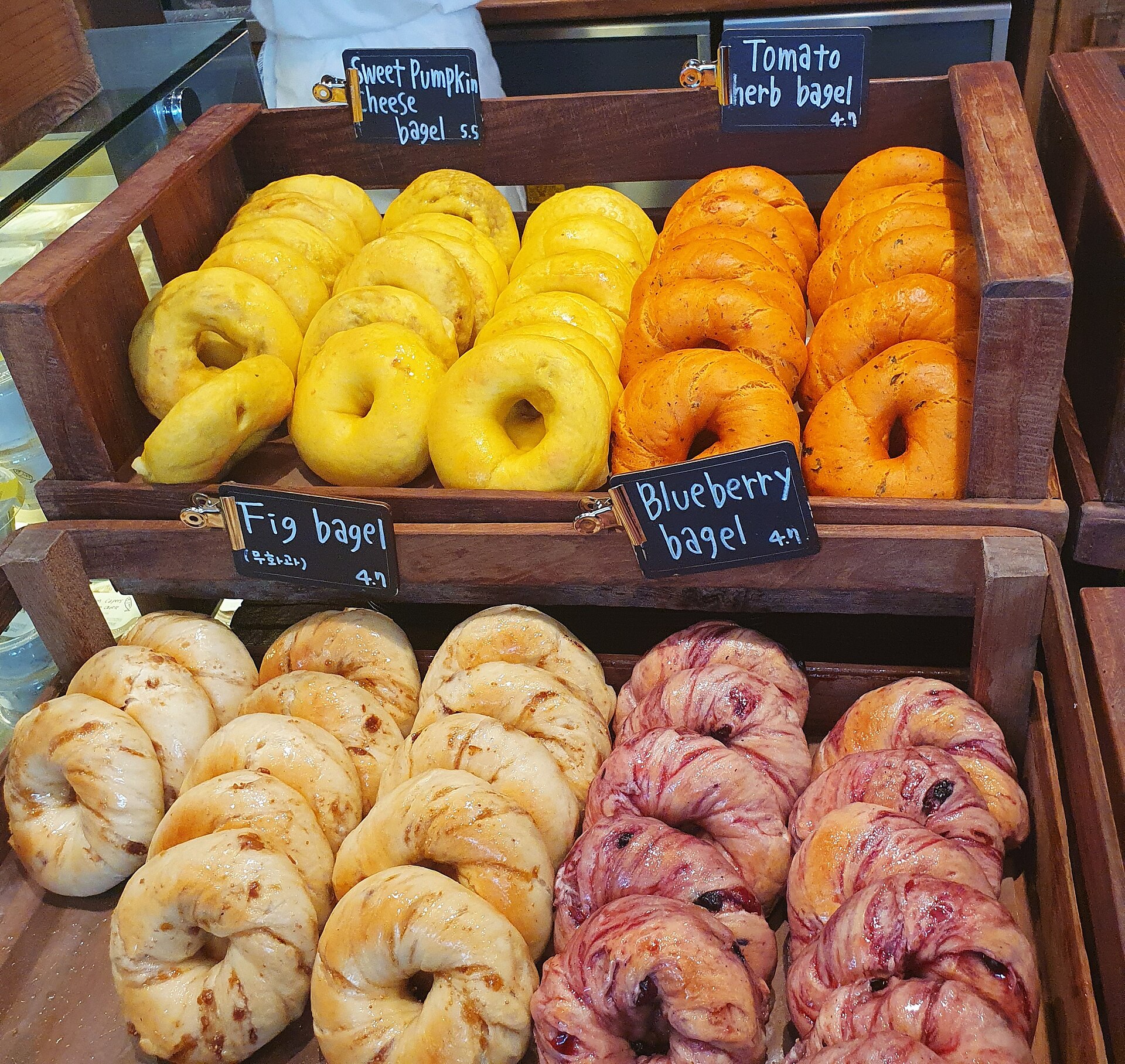
That world was especially powerful because it was hybrid. The product resembled a Western bagel, but its texture, fillings, and affective register were distinctly Korean. English-language food writing has noted that the brand's bagels differ from traditional North American ones, often appearing smaller, softer, and more oriented toward sweet-savory combinations. This distinction matters. London Bagel Museum did not win by imitating New York. It won by translating the bagel into Korean emotional retail.
The brand's genius lay in making this translation feel natural. Spring onion cream cheese, potato cheese, dark chocolate, fig, soup, thick sandwiches, playful merchandise, and soft brown interiors all belonged to the same universe. The food was not separated from the room. The room was not separated from the photograph. The photograph was not separated from the social media post. The post was not separated from the identity of the consumer who had managed to get inside.
This is how a bakery becomes a media object.
The queue as advertising
For London Bagel Museum, the queue was the most efficient advertising medium. It required no billboard, no celebrity endorsement, no conventional campaign. The bodies outside the door did the work.
In marketing terms, the queue produced social proof (Cialdini, 2009). A crowded shop tells passersby that value has already been collectively verified. Scarcity converts inconvenience into prestige. Waiting becomes not a failure of service design but an index of desirability. In Seoul's compressed commercial landscape, where cafés often function as identity theaters, waiting can become part of the commodity.
This dynamic was not limited to Korean consumers. Japanese travel and bakery reviews repeatedly described London Bagel Museum as a must-visit Korean café, famous for long lines, elaborate interiors, and a deeply consistent London-themed world. One Japanese bakery-tour account described the shop as if visitors were entering a storybook-like space, with furniture, props, tableware, uniforms, and takeout packaging all organized around a single aesthetic concept.
This is why London Bagel Museum matters beyond food. It belongs to a generation of Korean lifestyle brands that understand the city as media. A store is no longer merely a place where a transaction occurs. It is a stage, a backdrop, a caption, a proof of cultural literacy. The customer does not simply eat the bagel. She performs having been there (Goffman, 1959).
The locations amplified this logic. Anguk, Dosan, Jamsil, Jeju, department stores, and retail complexes were not random sites. They were already dense with cultural mobility: hanok tourism, luxury consumption, mall culture, domestic travel, beauty retail, K-pop itineraries, and café hopping. London Bagel Museum entered these flows and became part of them. It did not simply sell food in the city. It converted the city into a distribution system for desire.
The Japanese market made this even more visible. Japanese-language reporting has described the rise of Korean-style bagel consumption among Japanese tourists and consumers, including the emergence of "bagel activity" as a term for visiting bagel shops, baking bagels at home, and even traveling to Korea to experience Korean-style bagels. Here, the logic of K-culture appears in miniature. Korea does not merely export music, dramas, cosmetics, or fashion. It exports moods, textures, queues, flavors, interiors, and rituals.
London Bagel Museum was, in this sense, a soft-power retail object.
Images
London Bagel Museum × Frieze Seoul 2024 — The brand's cultural positioning extended beyond food into the contemporary art world, partnering with Frieze Seoul at COEX (September 4–7, 2024). The interior of London Bagel Museum in Seoul, featuring carefully curated vintage fixtures and warm lighting designed to evoke a London aesthetic. The brand's success relied heavily on creating an Instagram-worthy environment.
"노동자는 오브제가 아니다 (Workers are not objects)" — Green Party activists protest outside London Bagel Museum following the 2025 worker death and the Ministry of Employment and Labor's February 2026 inspection findings. The demonstration crystallized the tension between the brand's curated warmth and its labor conditions. An array of bagels and pastries at London Bagel Museum, including signature varieties like spring onion pretzel bagel and cinnamon raisin bagel. The product design reflected a hybrid approach between Western bagel traditions and Korean café culture preferences.
Then came the institutional report
The trouble with a brand built on atmosphere is that atmosphere cannot be separated forever from the conditions of its production.
In February 2026, South Korea's Ministry of Employment and Labor released the results of a special labor inspection into LBM and its affiliates. The inspection followed public controversy surrounding the death of a young worker in 2025 and covered 18 LBM-related entities between late October 2025 and January 2026. According to the ministry, the inspection included anonymous surveys of 430 employees and face-to-face interviews with 454 people.
The findings were severe. Authorities identified violations related to overtime limits, wage payment, workplace harassment, penalty clauses, occupational safety, health checkups, and safety-management obligations. The ministry imposed administrative fines totaling 801 million won and ordered corrective action on 564 million won in unpaid wages, including overtime, night, and holiday allowances. It also found that, in the week before the Incheon branch opened in July 2025, six workers other than the deceased had worked more than 70 hours.
For many brands, such a report would be damaging. For London Bagel Museum, it struck at the core of the promise.
The brand had sold warmth. It had sold care. It had sold handmade abundance, old-world charm, and a feeling that every object in the room had been lovingly chosen. But once labor violations become part of the public story, the emotional architecture changes. The quaint interior is no longer innocent. The abundance of goods becomes a question of staffing. The long queue, once a symbol of demand, becomes a possible sign of pressure placed on workers.
A bakery can survive bad reviews. It can survive a competitor. It can even survive a decline in novelty. What is harder to survive is a collapse in moral atmosphere.
Private equity enters the room
The timing of the crisis matters. In 2025, JKL Partners, a Seoul-based private-equity firm, moved to acquire LBM. Multiple reports placed the expected acquisition price around or above 200 billion won, reflecting the extraordinary market value attached to a relatively young Korean bakery brand.
From an investor's perspective, the appeal was obvious. London Bagel Museum had what food-and-beverage businesses dream of: dense foot traffic, high margins, brand heat, expansion potential, merchandise possibilities, and overseas relevance. It was not merely a restaurant chain. It was a scalable lifestyle asset.
But private equity changes the cultural reading of a brand. A founder-led café can be interpreted as personal, eccentric, imperfect, artisanal. A private-equity-owned café is interpreted through a different grammar: efficiency, rollout, standardization, valuation, and exit strategy.
That does not make private equity inherently harmful. Professionalized governance may be exactly what a rapidly growing founder-centered company needs. But it does make the contradiction sharper. A brand that became valuable by looking handcrafted must now prove that it can grow without becoming extractive.
After the labor ministry's findings, LBM reportedly accepted the inspection results, apologized for shortcomings in labor-environment management, and announced leadership changes, including the resignation of CEO Kang Kwan-gu. The symbolic meaning was clear: this was no longer a matter of store-level inconvenience or isolated managerial error. It had become a governance crisis.
The problem of emotional capitalism
London Bagel Museum is a case study in emotional capitalism at café scale.
It monetized affect. It transformed nostalgia, fantasy, scarcity, and cosmopolitan aspiration into a retail experience. Its success depended on the consumer's willingness to believe that a bagel could carry a world. That is not trivial. Modern consumption increasingly works this way (Williams, 2013). Consumers do not simply purchase food. They purchase participation in a scene.
But emotional capitalism has a built-in vulnerability. The more a brand asks consumers to love it, the more consumers expect it to be lovable behind the scenes.
A discount chain may be judged mainly by price. A luxury house may be judged by craftsmanship and status. But an emotional café brand is judged by congruence. Does the backstage match the front stage? Does the care displayed to customers extend to workers? Does the hand-drawn logo conceal an industrialized labor regime? Does the founder's aesthetic sensitivity coexist with managerial responsibility?
This is why the London Bagel Museum controversy has traveled so widely. It is not only about one bakery. It speaks to a broader Korean economy of desire in which small spaces become national phenomena almost overnight, propelled by social media and then absorbed into investment logic. The cycle is familiar: discovery, queue, virality, expansion, valuation, imitation, fatigue, scandal, reinvention.
In that cycle, the worker often appears last.
Still powerful, no longer innocent
It would be too simple to declare London Bagel Museum finished. The brand remains commercially resilient. Its product remains desirable. Its stores still attract consumers, including foreign tourists who may know more about its reputation than its controversy. Its aesthetic grammar remains influential across Korean café culture.
Nor should one underestimate the strength of novelty memory. For many visitors, especially those arriving from overseas, London Bagel Museum remains part of the Seoul itinerary alongside hanok cafés, beauty stores, department-store food halls, K-pop landmarks, and neighborhood walks. Japanese-language coverage continues to situate Korean bagels within a broader tourism and dessert trend.
But the brand is no longer innocent.
That is the decisive change in 2026. Before the labor controversy, London Bagel Museum could be read primarily as a charming example of Korean retail creativity. After the labor ministry's report, it must also be read as a test of whether Korea's new generation of lifestyle brands can mature institutionally as quickly as they mature aesthetically.
The future of London Bagel Museum will not be determined by whether it can open more shops. It has already proved that people will come. The harder task is to prove that the organization behind the fantasy is worthy of the devotion it has generated.
What recovery would require
The usual corporate apology will not be enough. A brand like this cannot recover through language alone because its crisis is not linguistic. It is operational.
A meaningful recovery would require labor transparency. Not a vague promise of improvement, but visible metrics: average weekly hours by store, overtime compliance, wage correction, rest-time enforcement, and independent auditing. It would require the company to publish these metrics regularly, the way luxury houses publish sustainability reports or tech companies publish diversity statistics.
It would also require a reckoning with the speed of growth itself. The expansion from one location to dozens of stores in just a few years may have been commercially brilliant. But it may also have been organizationally reckless. A brand that depends on handcrafted atmosphere cannot simply be replicated through standardized procedures. The question is whether LBM can acknowledge this without losing its market value.
Most difficult of all, recovery would require the company to accept that it is no longer a founder-led artisanal brand. It is a significant Korean corporation with real power over workers' lives. That shift in self-understanding—from creative visionary to institutional actor—is what separates redemption from mere damage control.
Conclusion
London Bagel Museum will not disappear. Desire does not evaporate so easily, especially in Seoul, where the appetite for new experiences and curated atmospheres remains enormous. The brand may recover. It may even thrive.
But something has changed. The queue outside the shop is no longer a pure symbol of success. It is now also a question mark. Every person waiting is now also asking: What am I participating in? What does this line cost? Who paid the price for my pleasure?
These are uncomfortable questions for a brand built on beauty and ease. But they are also necessary ones. And they will not disappear as quickly as the queue.
References
Cialdini, R. B. (2009). Influence: Science and practice (5th ed.). Pearson Education.
Goffman, E. (1959). The presentation of self in everyday life. Doubleday.
Hennig-Thurau, T., Groth, M., Paul, M., & Gremler, D. D. (2009). Are all smiles created equal? How emotional labor and genuine emotion labor influence service relationships. Journal of Marketing, 73(3), 58-73.
Williams, R. (2013). Dream worlds: Mass consumption in late nineteenth-century France. University of California Press.
Zuboff, S. (2019). The age of surveillance capitalism: The fight for a human future at the new frontier of power. PublicAffairs.