A Bowl, a Partition, a Brief Reprieve
Why 미분당 (Mifendang) is not really in the pho business at all
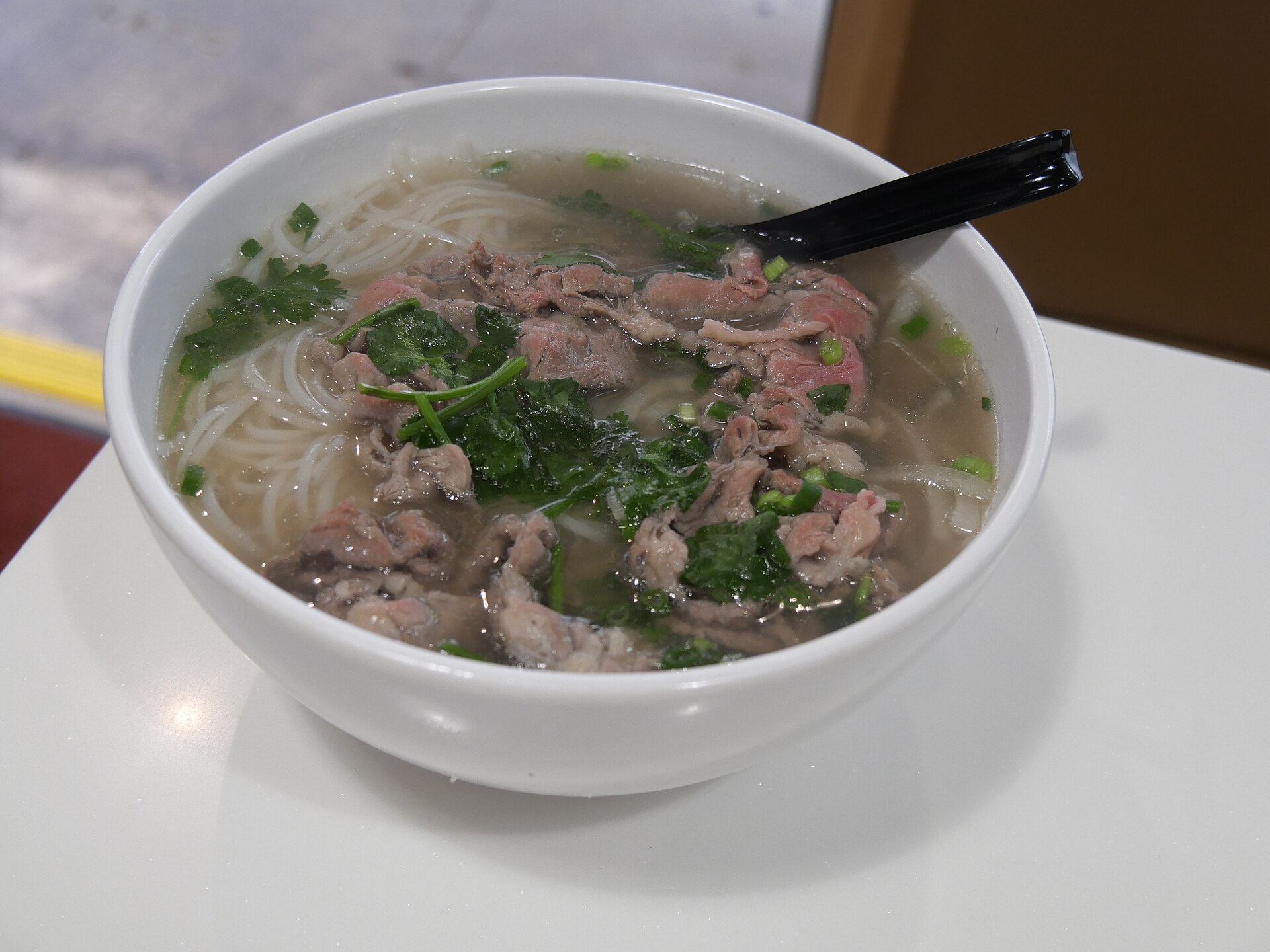
In most restaurant economies, brands compete by promising more: more flavor, more authenticity, more abundance, more noise that can be mistaken for life. 미분당 (Mifendang) built its reputation in South Korea by offering something rarer and, in a dense city, arguably more valuable: less. On its official brand page, the company describes itself as a reinterpretation of Vietnamese rice noodles, one filtered through Korean taste, a Japanese-style spatial mood, and even a Chinese-character name, 米粉堂, literally "rice noodle hall." The point is not purity. It is composition. What the brand sells is not a faithful reproduction of Vietnam so much as a carefully assembled Korean answer to the problem of how urban people now want to eat.
That difference matters. The modern diner in Seoul is not always chasing stimulation, novelty, or sociability. Increasingly, the aspiration is the opposite: a meal stripped of friction. 미분당's menu remains unusually disciplined, centered on a compact range of beef and seafood rice-noodle variations. The restraint is strategic. A smaller menu narrows choice, speeds ordering, and makes the experience feel less like a small ordeal of decision-making than a controlled pause in the day. Even before one tastes the broth, the brand has already made its argument: excess is not always hospitality. Sometimes hospitality means removing what exhausts people.
Its real innovation lies in the choreography of consumption. Counter seating, visual separation, compressed circulation, and the brand's widely recognized atmosphere of 정숙 (quiet restraint) turn eating into a low-contact ritual. The restaurant does not merely accommodate 혼밥 (honbap, eating alone); it legitimizes it. That distinction is essential. Many places tolerate solo diners. 미분당 appears designed for them. In this sense, it is less useful to call the company a Vietnamese restaurant chain than a Korean solitude-management brand, one that monetizes 안도감 (relief) and 정돈 (orderliness) in an overstimulated city. This is precisely why the brand has mattered enough to defend not only its logo or menu but its overall look and feel. In 2023, a Seoul court granted Mifendang's request to stop a rival, 월미당 (Wolmidang), from using a similar interior and exterior presentation, underscoring that its trade dress and service environment had become commercially distinctive assets.
That legal dispute revealed something larger about contemporary brand value in South Korea. For decades, restaurant imitation often focused on recipes, naming, or price points. In 미분당's case, the object worth copying was atmosphere itself: wood signage, spatial rhythm, partitioned seating, the suggestion of stillness. The chain's defensible product was not just broth. It was a behavioral environment. For a country whose global consumer image is often narrated through intensity, speed, glamour, and saturation, that is a quietly radical proposition. 미분당's success says that Korean branding now extends beyond spectacle into the engineering of emotional temperature. The brand does not ask how to excite the diner. It asks how to calm the diner down.
The Demography of Solitude
How 1인 가구 (one-person households) turned 혼밥 (eating alone) from social exception into market logic
No restaurant concept can be understood apart from the household structures that make it legible. South Korea's demographic shift has been so pronounced that it now reads less like a trend than an instruction manual for the economy. According to the government's 2025 statistical summary on one-person households, 1인 가구 (one-person households) reached 8.045 million in 2024, accounting for 36.1 percent of all households. More broadly, one- and two-person households together accounted for 65.1 percent of general households. A generation ago, that would have sounded like a sociological footnote. Today it is a blueprint for retail, housing, delivery platforms, convenience stores, and, of course, restaurants.
Those numbers do more than explain why solo dining has grown. They explain why it has become culturally ordinary even while retaining emotional complexity. In a highly urbanized society, solitude is no longer necessarily deviant, but it is not always frictionless. Eating alone can still carry traces of 노출 (exposure): the sense of being visible, unpaired, unoccupied by conversation, insufficiently shielded from the gaze of others. What 미분당 grasped is that the key consumer problem was not whether people would eat alone, but whether they could do so without performing a justification for it. The restaurant's appeal lies in its ability to remove interpretive burden. You do not need to look busy. You do not need to linger. You do not need to explain your aloneness through efficiency, sadness, or work. You simply occupy the seat assigned to one person.
The Architecture of Restraint
The brand's spatial design encodes this logic. Counter seating, which dominates the interior, is not merely a cost-saving device. It is a permission structure. A counter seat is inherently solo-friendly; the customer's aloneness is not exceptional or exposed but normalized by the format itself. The visual separation—screens, partitions, the spatial choreography that keeps diners from seeing each other's faces—removes what researchers in consumer psychology call "social facilitation effects," the tendency to feel evaluated by others' presence. The low-interaction service model (order at counter, minimal table-side attention, self-service water and condiments) further reduces the social friction that solo diners often experience. The result is an environment where eating alone is not tolerated but expected, where the spatial and service architecture actively supports rather than merely accommodates it.
This is why the 2023 trade-dress dispute matters more than it might appear. When Mifendang sued Wolmidang for copying its interior design and visual presentation, the case was not really about wood signage or the color of the walls. It was about defending the right to own a particular emotional and spatial logic—one that had become commercially valuable precisely because it solved a real consumer problem in a way that felt novel and, crucially, culturally legible. The court's decision to grant the injunction recognized that the "look and feel" of a restaurant could be a defensible intellectual property asset, not merely a design preference but a functional component of the brand's value proposition.
The Limits of Subtraction
And yet this very success exposes structural vulnerabilities. A brand built on subtraction—on removing choice, interaction, and social complexity—is inherently limited in its expansion potential. The more units a concept adds, the more it must standardize. Yet in brands like 미분당, excessive standardization can flatten the fragile atmosphere that customers actually came for. Quiet is hard to franchise. Calm is hard to operationalize.
Moreover, occasion-based brands can be intensely loved and structurally narrow at the same time. 미분당 is powerful when the customer wants privacy, speed, and order. It is much less compelling when the customer wants hospitality in the older sense: sociability, conversation, a meal that expands rather than contracts the evening. That asymmetry is not a flaw, exactly, but it does define the ceiling.
The second challenge is experiential fatigue. A concept built on subtraction can feel elegant at first and severe later. The same quiet that reads as 배려 (consideration) to one diner may feel like 압박 (pressure) to another. Minimal choice can reduce cognitive load, but it can also begin to look like conceptual monotony if not renewed. This is the burden of highly distilled brands: they are remembered clearly, but they can also be exhausted clearly.
A Document of Korean Economic Culture
And yet this is precisely why 미분당 deserves to be read as more than a successful restaurant chain. It is a small but revealing document of Korean economic culture in the mid-2020s. It shows a country whose consumer markets are no longer organized solely around aspiration, abundance, or spectacle, but increasingly around management of depletion. If K-beauty perfected ritual and K-pop perfected intensity, then 미분당 has, in its own narrow lane, perfected a form of commercial quiet. It suggests that one frontier of advanced urban capitalism lies not in getting consumers to want more, but in giving them permission to endure less. That may sound like a modest achievement. In Seoul, it is a profound one.