When Seoul Became a Map Before It Became a Destination Naver Map's "BE LOCAL" Campaign and the New Grammar of Urban Marketing
For a foreign traveler arriving in Seoul, the city no longer begins at Gyeongbokgung Palace, Namsan Tower, or a hotel lobby. It begins earlier, at the airport screen, the railway platform, the subway exit, the bus shelter, the wall of a building in Itaewon, the LED surface in Myeongdong, and finally the glowing interface of a mobile map. The city appears first not as scenery, but as a sequence of cues. In that sense, Naver Map's "BE LOCAL" campaign is more than a tourism promotion. It is a case study in urban communication: the transformation of the city itself into a navigational medium.
BE LOCAL — Discover Korea Like a Local with Naver Map, in partnership with Korea Tourism Organization (한국관광공사)
The campaign's proposition is simple but strategically powerful: do not merely visit Seoul; move through it like a local. In April 2025, Naver Map launched "BE LOCAL" for foreign-language users, presenting trend-driven restaurants, cafés, shopping venues, pop-ups, and cultural spaces favored by younger Korean users. The campaign did not simply advertise a map application. It reframed the app as a gateway into Seoul's living texture — not the official city of monuments, but the practiced city of eating, walking, photographing, shopping, and wandering.
The most interesting part of the campaign is not its slogan but its sequencing. It placed messages along the traveler's actual journey: arrival, transfer, urban entry, local exploration, and mobile search. According to the campaign review, the OOH component generated approximately 36.8 million OTS, but its more important achievement was not scale alone. The impressions were choreographed across a visitor's movement path, turning airports, rail corridors, commercial districts, and mobile search behavior into one continuous communication circuit.
Behind that choreography was All Is Well, the Korean OOH-centered integrated media company that planned and executed the campaign. The point is not to foreground the agency as the story's hero. Rather, its involvement reveals a broader industrial shift: outdoor media companies are no longer simply securing surfaces. They are increasingly asked to read the city, understand mobility, and arrange media encounters as part of a traveler's lived sequence.
From Billboard to Behavior
The Campaign Did Not Just Show Seoul. It Taught People How to Use It.
Traditional outdoor advertising has long been judged by visibility: location, size, traffic, frequency, and visual dominance. The "BE LOCAL" campaign points to a different metric: whether the advertisement can change movement. This is where the campaign becomes a useful marketing case. It does not treat OOH advertising as a static billboard. It treats it as a behavioral bridge between urban curiosity and platform use.
Naver Map's BE LOCAL campaign billboard at night in Seoul — the campaign placed messages along the traveler's actual movement path across the city.
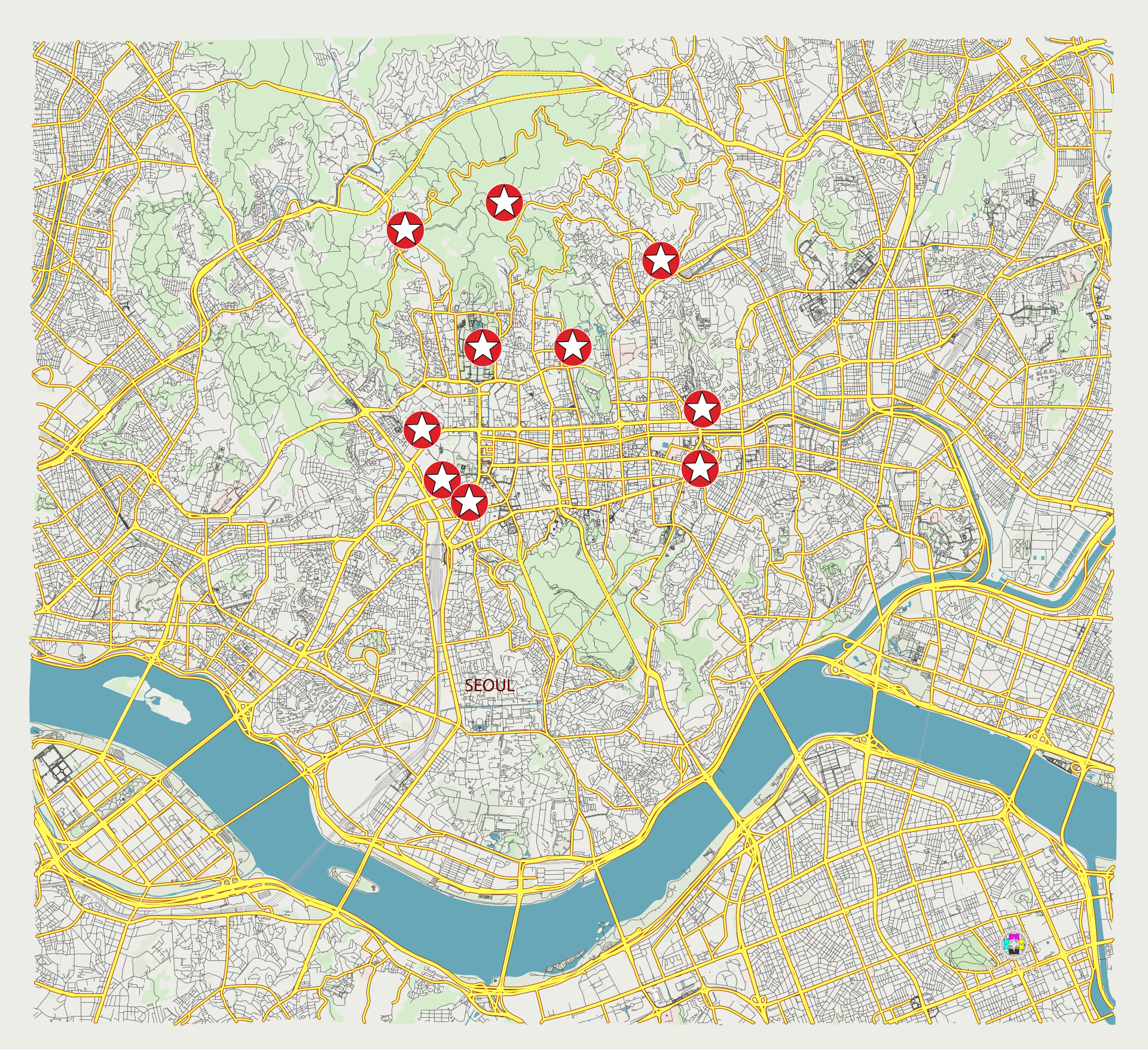
At the airport, the message meets the traveler at a moment of uncertainty: where to go, what to eat, how to move, which app to trust. On the airport railway, the message repeats during a transitional interval. In Myeongdong, Seongsu, and Itaewon, it meets the traveler near possible points of action. In the app, it converts attention into search, saving, routing, and visiting. The campaign therefore links outdoor advertising, mobile mapping, place curation, and tourist behavior into a single funnel.
This is why "BE LOCAL" works better as an experience proposition than as a purely functional app advertisement. A weaker campaign might have said, "Naver Map gives directions." This campaign says something more emotionally precise: "You can belong to the city for a day." That distinction matters. Tourists rarely want only efficiency. They want confidence, discovery, social proof, and a feeling of insider access. Local here is not a demographic category. It is a psychological reward.
The campaign's language — PLAY, TASTE, SNAP, SHOP — also deserves attention. These are not technical features; they are verbs of urban behavior. They transform a map from a utility into a lifestyle interface. The app becomes less about getting from point A to point B and more about entering the city's living rhythm. In marketing terms, this is a shift from functional communication to experiential framing. In urban terms, it is a shift from place promotion to movement design.
The strongest campaigns today do not merely announce a service. They create the moment in which that service becomes necessary. "BE LOCAL" does this by allowing Seoul itself to generate the need. A traveler sees a street, a district, a crowd, a food scene, a hint of local life — and then needs a map not as a tool of correction, but as a tool of participation. The campaign succeeds because it understands that navigation is emotional before it is technical.
The City as Interface
Why "BE LOCAL" Matters for Korean Tourism, Platform Strategy, and Urban Communication
The campaign arrived in a uniquely Korean platform environment. For many foreign visitors, South Korea has long been a paradox: one of the world's most digitally advanced countries, yet a place where global mapping services do not always deliver the same level of local usefulness that visitors expect elsewhere. In this environment, Naver Map is not simply a convenience tool. It becomes part of Korea's practical tourism infrastructure.
Against that background, "BE LOCAL" is not simply a brand campaign. It is a platform onboarding campaign disguised as a city experience. It teaches foreign visitors that the way to move through Korea is not only to translate signs or follow guidebooks, but to enter the country's local digital infrastructure. The campaign sells a behavior before it sells a service: open the map, follow local taste, save the place, move through the city.
Its creative strength lies in the fusion of place and platform. Seoul is not reduced to postcard images. Instead, it is presented as a set of live urban choices: where people eat, shop, photograph, gather, and wander. This is closer to how younger travelers actually consume cities. They do not merely visit landmarks; they collect atmospheres. They search for cafés, alleys, pop-ups, photo spots, and neighborhoods that feel discoverable. The campaign understands this shift from sightseeing to taste-seeking.
Yet the case also reveals a limitation. The more emotionally polished a service campaign becomes, the more carefully it must preserve functional clarity. The campaign review notes that some respondents found it difficult to immediately understand from the advertising alone that the message was for a map service, or how exactly the app should be used. That is not a fatal weakness; it is a useful design lesson. Future executions could more explicitly show the app journey: search, save, route, translate, take transit, arrive.
The larger implication is clear. Good OOH no longer simply asks people to look. It asks them to move. Better still, it tells them how to move, where to go, and why the journey will feel meaningful. In that sense, "BE LOCAL" represents a qualitative shift in Korean outdoor advertising: from exposure to orientation, from signage to service, from media placement to urban behavior design.
For marketers, the campaign offers three lessons. First, location is not just a media-buying variable; it is a narrative device. Second, mobile services become persuasive when they are embedded into lived moments of need. Third, tourism marketing now depends less on showing famous places and more on designing pathways into local culture.
The campaign's final achievement is therefore conceptual. It reminds us that the city is no longer merely where advertising appears. The city is part of the advertising system itself. Seoul becomes the screen, the route, the prompt, the database, and the emotional promise. Naver Map's "BE LOCAL" campaign succeeds because it understands that foreign travelers do not only need directions. They need permission to feel briefly native to a place they have just entered.
The old advertisement stopped people in the street. The new advertisement teaches them how to walk through it.
References
All Is Well. (2025). OOH media campaign report: Naver Map "BE LOCAL" campaign result report. Internal campaign report.
Korea JoongAng Daily. (2025, April 14). Naver Map's "Be Local" campaign helps foreign nationals discover Seoul.
Korea Tourism Organization. (2025). [KTO × NAVER Map] BE LOCAL. VisitKorea.
Lee, G.-L. (2025, September 17). Naver Map launches another BE LOCAL campaign, expands to Busan, Gyeongju. The Korea Times.
Lee, M. (2025, September 17). Naver Map introduces Korea's hotspots to foreign tourists with second "BE LOCAL" campaign. Asia Business Daily.