The Pot That Remembered the War
How Uijeongbu's Budae Jjigae Became an Urban Language of Modern Korea
There are cities that speak through glass towers, renovated train stations, riverfront promenades, and carefully lit museums. Uijeongbu speaks, at least in one of its most revealing registers, through a boiling pot.
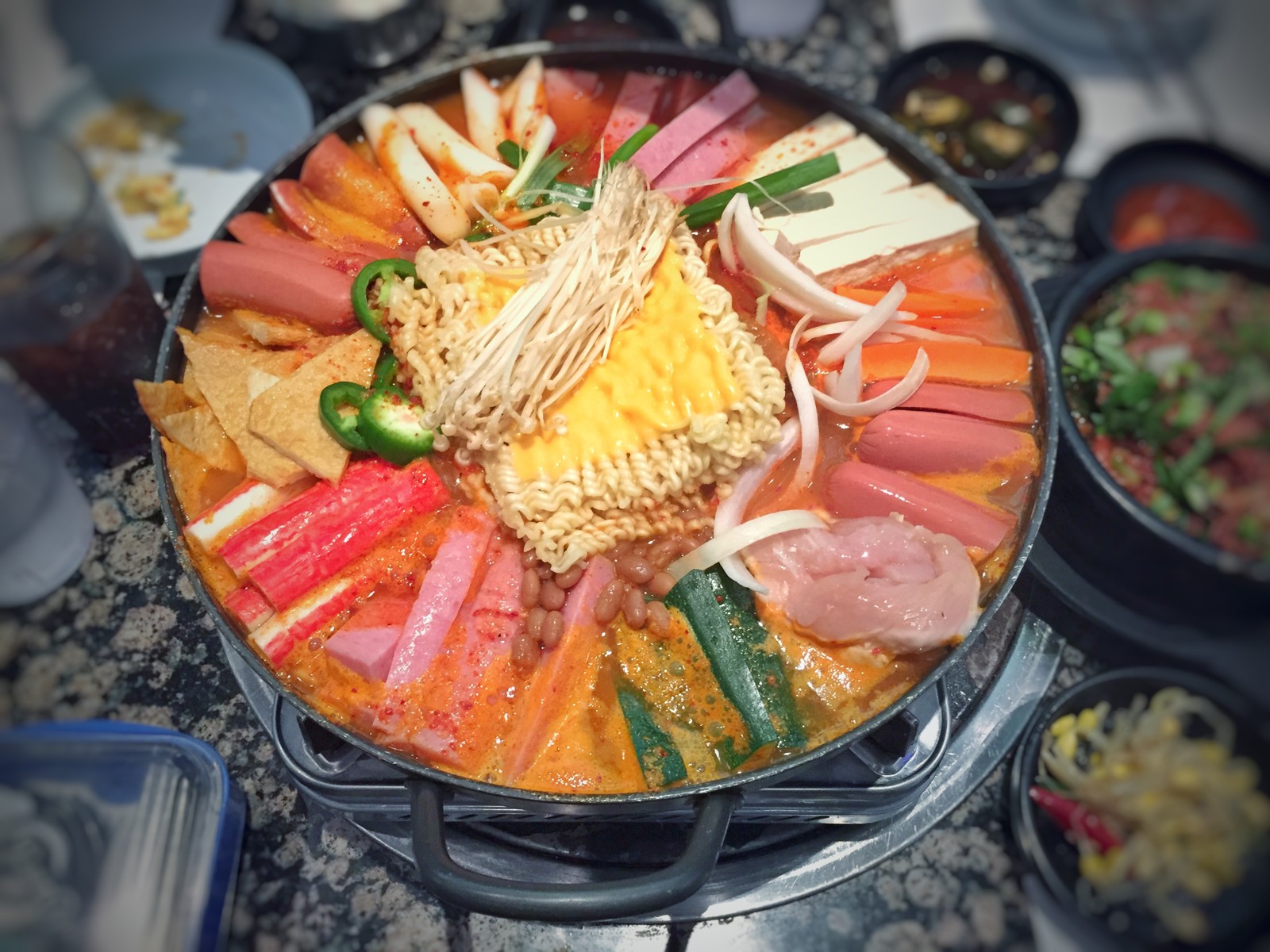
Walk into the city's budae jjigae street (부대찌개거리) and the first message is not visual but atmospheric: steam rising from metal pots, red broth thickened by gochujang, kimchi meeting sausage, Spam surrendering to spice, instant noodles softening into history.
It is not an elegant dish in the conventional sense. It does not pretend to descend from royal court cuisine or Buddhist temple food. It is messy, improvised, excessive, and slightly improbable. And precisely because of that, it may be one of the most honest dishes in modern Korean food culture.
Budae jjigae (부대찌개) literally means "army base stew." The name carries history before the first spoonful arrives. The "army base" refers to the American military presence in Korea after the Korean War; the "jjigae" refers to one of the most intimate forms of Korean eating: a shared stew, placed at the center of the table, simmering while conversation unfolds around it.
In that union of words lies a compressed history of postwar scarcity, foreign military presence, urban adaptation, and Korean culinary translation.
Scarcity, Translated into Flavor
The origin story of budae jjigae begins not with abundance but with deprivation. Postwar Korea was a country of damaged infrastructure, food insecurity, displaced families, and American military logistics. Processed meats such as ham, sausage, bacon, and Spam were not yet casual supermarket items. They were foreign, salty, industrial, and valuable.
For many Koreans living near U.S. military bases, these ingredients represented both dependency and possibility.
Uijeongbu, located north of Seoul, was shaped by this postwar geography. Its proximity to American military installations made it one of the urban spaces where the materials of Cold War Korea passed into everyday life. What began as survival cooking gradually became commercial food culture.
The famous Odeng Sikdang (오뎅식당) is central to this story. It began in 1960 as a small street stall selling fish cakes. The owner reportedly began cooking with ham, sausage, bacon, and other ingredients obtained through people connected to nearby U.S. military bases. What had first been served as a kind of stir-fried accompaniment eventually became a stew because Korean diners wanted something warm, communal, and compatible with rice.
That transformation matters. The foreign ingredient did not remain foreign. It was absorbed into the Korean grammar of the table.
In a Western culinary imagination, sausage and ham might belong to sandwiches, breakfast plates, canned rations, or barbecue. In Korea, they were placed into jjigae. This was not mere improvisation. It was cultural translation (문화적 번역). The processed meat, with its fat and salt, was domesticated by kimchi's acidity, gochujang's heat, and the social ritual of shared boiling.
Budae jjigae does not romanticize poverty. It would be dishonest to turn deprivation into nostalgia too quickly. But the dish reveals something essential about Korean modernity: the ability to take the materials of asymmetry—military power, scarcity, dependency, foreign food systems—and reorganize them into everyday agency.
It is not the cuisine of purity. It is the cuisine of conversion.
The City as an Edible Archive
Every city has official and unofficial archives. The official archive is made of maps, documents, development plans, monuments, and municipal slogans. The unofficial archive is made of alleys, smells, shop signs, recipes, rumors, and repeated gestures.
Uijeongbu's budae jjigae street belongs to the latter.
This is why the street matters as urban communication (어반 커뮤니케이션). It is not simply a concentration of restaurants. It is a spatial narrative. The visitor does not merely consume food; the visitor moves through a memory system. The signs, queues, menus, old storefronts, festival banners, restaurant names, and multilingual travel references together produce a message: this is a city whose postwar history has become edible.
Food streets are often treated as minor tourist zones, but in many cities they perform serious cultural work. They organize memory. They stabilize identity. They transform scattered histories into repeatable experiences. New York has pizza slices and Jewish delis; New Orleans has gumbo; Osaka has takoyaki; Singapore has hawker centers. Uijeongbu has budae jjigae.
But Uijeongbu's case is sharper because the dish contains historical contradiction. It is both Korean and not originally Korean. It is local, yet born from geopolitical entanglement. It is comfort food, yet rooted in discomfort. It is now marketed to tourists, yet descended from a time when tourism was unthinkable.
That contradiction is not a weakness. It is the essence of the place.
Urban communication is often misunderstood as a matter of branding: better signage, better slogans, more Instagrammable facades. But a city does not become memorable because it has a logo. It becomes memorable when its spaces allow people to understand what has happened there.
Uijeongbu's budae jjigae street succeeds because it gives visitors a sensory way to encounter modern Korean history (한국 현대사). The pot does what many plaques fail to do. It makes history warm.
Why Foreign Visitors Understand the Dish Before They Understand the History
To foreign visitors, budae jjigae can first appear almost comical. Spam, sausage, ramen, kimchi, gochujang, cheese, and sometimes baked beans: this seems less like a recipe than an accident. Yet the dish often wins people over precisely because of its excess.
Its English name, Korean army stew, is unusually powerful. Many translated menu names flatten meaning, but this one intensifies it. It immediately raises a question: Why is there an army in my stew?
That question opens the door to history.
The flavor then does something equally direct. Budae jjigae is not subtle. It is salty, spicy, fatty, hot, and communal. It does not require an advanced education in Korean cuisine to understand its appeal. The dish arrives as an event: a pot placed in the middle of the table, ingredients still visibly separate, then slowly dissolving into one another as the broth thickens.
For international diners, that process is part of the attraction. They are not simply served a finished plate. They watch the transformation happen. They participate in timing: when to stir, when to add noodles, when the broth has deepened enough, when rice should enter the conversation.
This is not only eating. It is social choreography (사회적 안무).
Here, budae jjigae communicates one of the central features of Korean food culture: intimacy through shared heat. The table is not a private arrangement of individual plates but a temporary community built around a simmering center. Even for a visitor who knows little about the Korean War, the act of eating communicates something about Korean urban life: closeness, noise, negotiation, appetite, speed, and warmth.
In Japanese, the dish is commonly known as pude chige (プデチゲ), and it has become familiar through Korean food media and travel culture. In English-language tourism discourse, it is increasingly framed as a postwar fusion dish and a Korean comfort food.
These descriptions are useful, but they still understate its symbolic power. Budae jjigae is not merely fusion. Fusion often implies choice, creativity, and cosmopolitan leisure. Budae jjigae emerged from constrained circumstances. Its genius lies not in luxury but in adaptation.
That is why the dish feels contemporary. In a global era defined by migration, supply chains, military alliances, cultural hybridity, and urban reinvention, budae jjigae is not an old curiosity. It is a model of how cultures actually change.
Beyond "Original": What Uijeongbu Should Really Sell
Regional food branding often falls into the trap of origin claims. Who made it first? Which restaurant is authentic? Which city owns the dish? These questions can attract attention, but they cannot sustain a sophisticated urban identity on their own.
Uijeongbu's opportunity is larger than originality. The city should not merely sell the claim that budae jjigae began there. It should sell the experience of understanding why such a dish could have emerged there.
That requires a different form of urban storytelling (도시 스토리텔링).
At the entrance to the street, visitors should be able to encounter a concise historical timeline: the Korean War, the presence of U.S. bases, informal food circulation, the rise of Odeng Sikdang, the growth of the restaurant district, the transformation of budae jjigae into a national comfort food, and its contemporary reception among foreign tourists.
The story should be available in Korean, English, and Japanese—not as perfunctory translation, but as interpretation.
Menus should do more than list ingredients. They should tell the dish's logic. A short sentence could change the entire meal:
Born in postwar Uijeongbu, this stew transformed American military-base ingredients into a Korean communal dish through kimchi, gochujang, and shared boiling.
Such a line does not merely explain the food. It elevates the act of eating.
The street itself should be designed as a readable urban text. Archival photographs, maps, oral histories, old menus, illustrated ingredient diagrams, and audio snippets from restaurant owners could turn a meal into a cultural encounter. The point is not to museumize the street or drain it of everyday life. The point is to make its everyday life legible.
Uijeongbu should also connect the budae jjigae street to broader walking routes: traditional markets, cultural venues, public libraries, performance spaces, and traces of the city's modern military and commercial history. A dish becomes more powerful when it anchors a larger urban itinerary.
Visitors should not come only to eat and leave. They should eat, walk, read, and remember.
In the language of place branding (장소 브랜딩), this is the difference between selling a product and communicating a place. A product satisfies demand. A place creates meaning.
The Beauty of an Impure City
The deepest lesson of Uijeongbu's budae jjigae is that cities are not made from purity. They are made from mixture.
Modern cities are never innocent. They carry traces of violence, trade, migration, labor, occupation, aspiration, and accident. Their identities do not emerge from clean beginnings but from the difficult work of recomposition.
Uijeongbu's budae jjigae shows this with unusual clarity. American processed meat, Korean fermented vegetables, military geography, market improvisation, industrial noodles, and communal dining all come together in a single pot.
This is not a flaw in the dish. It is its truth.
To call budae jjigae "inauthentic" because it contains Spam would be to misunderstand both food and history. Authenticity is not always a matter of ancient origin. Sometimes it is a matter of faithful transformation. Budae jjigae is authentic because it honestly bears the marks of the conditions that produced it.
It does not pretend that Korea's modern history was sealed off from foreign power. It does not hide the improvisations of poverty. It does not polish away the awkwardness of its ingredients.
Instead, it boils them together.
That may be why the dish feels so urban. Cities are also forms of boiling. They take incompatible elements and force them into proximity. They turn accidents into routines, routines into commerce, commerce into memory, and memory into identity.
Uijeongbu's budae jjigae street is one such urban pot.
The city's real asset, then, is not only the stew. It is the capacity to tell a difficult story without making it abstract. The Korean War, American military presence, postwar scarcity, local entrepreneurship, and global food curiosity are not easy subjects. But in Uijeongbu, they can be approached through steam, spice, and a shared table.
That is what makes this street important. It does not monumentalize history. It metabolizes it.
In the end, Uijeongbu's budae jjigae is not simply a dish that survived the war. It is a dish that learned how to remember the war without remaining trapped inside it. It turned leftovers into livelihood, foreign ingredients into Korean flavor, scarcity into abundance, and a local alley into an urban message.
Some cities speak in marble. Some speak in neon. Uijeongbu speaks in broth.
And in that broth, modern Korea is still boiling.
References
Korea Tourism Organization. (n.d.). Budaejjigae: The West meets Korea in a pot. Visit Korea.
Korea Tourism Organization. (n.d.). Uijeongbu Budaejjigae Street. Visit Korea.
Korea Tourism Organization. (n.d.). 議政府プデチゲ通り. Visit Korea Japan.
Lee, H. R. (2024, November 14). Uijeongbu carries on culinary legacy as birthplace to Korea's comfort food, budae jjigae. The Korea Times.
Odeng Sikdang. (n.d.). Origin story of Odeng Sikdang. Odeng Sikdang.
Uijeongbu City. (n.d.). Uijeongbu Budaejjigae. Uijeongbu City English Website.