A Waterfall That Teaches a City How to Speak
At Hongje Falls (홍제폭포), in Seoul's northwest, infrastructure becomes atmosphere, atmosphere becomes memory, and memory becomes a reason to return.
The Quiet Revolution of Urban Sensation
There are places in Seoul that seem born to be iconic. The palaces arrive already wrapped in history. The Han River (한강) carries the weight of civic myth. Namsan (남산) has long belonged to the city's postcard imagination. And then there are places that were not destined for symbolism at all, places that acquire meaning later, almost quietly, by changing how a city presents itself to the world.
Hongje Falls (홍제폭포), in Seodaemun-gu (서대문구), is one of those places.
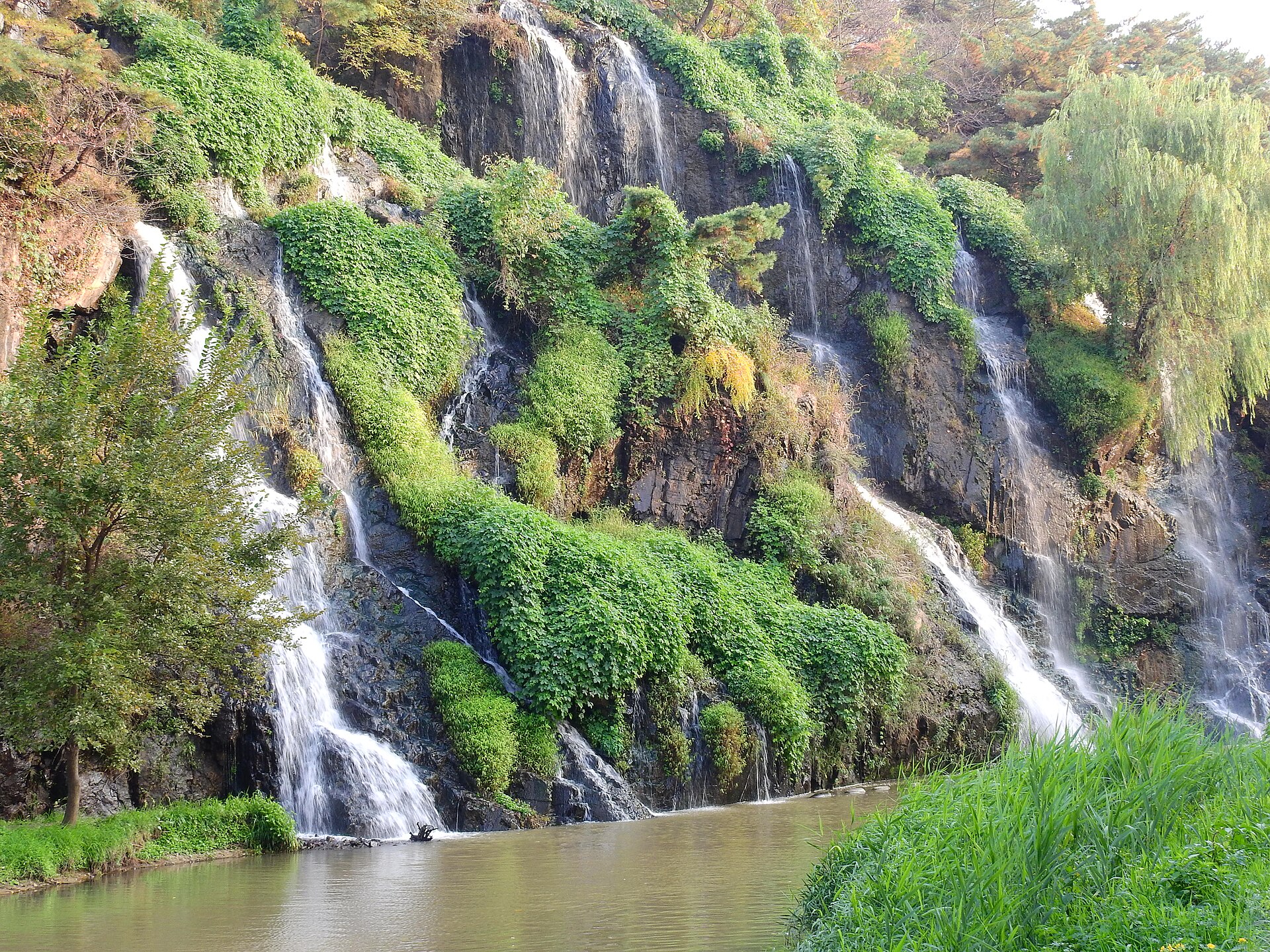
It is not a natural wonder. It does not pretend to be ancient. Official tourism sources describe it plainly as an artificial waterfall, first created in 2011, measuring about 25 meters in height and 60 meters in width. Yet what matters here is not the engineering alone, but the afterlife of that engineering: the way a public works project became a piece of urban language, and the way an ordinary district in northwest Seoul learned to speak through water, light, and pause.
Hongje Falls is compelling precisely because it is not sublime in the old sense. It is composed, framed, and designed. It belongs to that distinctly contemporary category of places that are less about untouched nature than about the careful translation of nature into an urban mood. The waterfall rises not in a remote valley but beside civic infrastructure, and in recent years the surrounding area has been reshaped with waterside terraces, Café Pokpo (카페폭포), and spaces for reading and rest, transforming what might once have been a passing glance into a destination for lingering.
For foreign visitors, this is part of the appeal. Hongje Falls does not offer the grand familiarity of Gyeongbokgung (경복궁) or the hyper-legibility of Myeong-dong (명동). It offers something more revealing. It shows a different Seoul: not merely fast, vertical, and overstimulated, but edited, atmospheric, and capable of emotional restraint. One does not come here to witness wilderness. One comes to see how a city manufactures calm.
The City as Medium
Urbanists often speak of infrastructure as necessity, planners as utility, and media scholars as representation. Hongje Falls collapses those categories. It is infrastructure, yes, but also a medium. It conveys meaning before anyone says a word.
To stand before the waterfall is to understand that cities communicate not only through signage or monuments, but through orchestrated sensation. The falling sheet of water arrests the eye. The sound of it softens the auditory violence of the street. The mist changes the texture of the air. The body slows, almost involuntarily. In that moment, the city ceases to be mere background and becomes interface.
Hongje Falls, then, is not only a place to visit. It is a lesson in urban communication (어반 커뮤니케이션): how spatial design can guide attention, regulate tempo, and produce emotional orientation without ever becoming didactic.
This is why the site matters to more than tourists. For developers, it demonstrates that the value of a district may lie not only in large-scale redevelopment but in the cultivation of memorable scenes. For media scholars, it shows how place can function as content. For practitioners and students, it offers a vivid example of how public space becomes experience economy. In an era when cities compete not merely for investment but for affect, Hongje Falls suggests that atmosphere may be as strategic as architecture.
Its power lies in its refusal of grandeur. It is not a mega-project. It is not a skyline intervention. It does not rely on overwhelming scale or spectacular novelty. Instead, it works through precision: a framed view, a controlled rhythm, a sequence of spaces that move the visitor from circulation to pause. Recent Seoul policy and research materials treat the Hongjecheon (홍제천) area as part of a broader waterside sensibility strategy, one that seeks to turn underused urban edges into emotionally resonant civic environments.
In this sense, Hongje Falls is best read not as scenery but as syntax. It teaches the city a new sentence structure. It says: here, you may slow down.
The Artificial and the Persuasive
There is, of course, a paradox at the heart of the place. Hongje Falls is artificial. That fact is impossible to miss, and for some observers, impossible to forgive. Scholarship on urban stream restoration in Korea has noted the tension between ecological authenticity and aesthetic staging, suggesting that some restoration projects operate less as returns to nature than as highly managed landscape performances.
Hongje Falls belongs unmistakably to that tension. And yet it is precisely this artificiality that makes the site so revealing. The contemporary city is full of spaces that no longer derive legitimacy from purity, only from persuasiveness. Visitors do not arrive believing they have discovered pristine wilderness. They arrive knowing the space has been designed, and nonetheless allowing themselves to be moved by it. That is not a failure of authenticity. It is a shift in the terms by which urban experience is judged.
English-language reactions capture this particularly well. Coverage and traveler commentary have described Hongje Falls as "an urban oasis" and "surprisingly calming," language that does not mistake it for natural heritage but values it as an unexpected pocket of emotional release within a dense metropolis.
What matters, then, is not whether the waterfall is "real" in the Romantic sense, but whether the experience it produces is convincing. Can it interrupt the city's relentless tempo? Can it invite stillness? Can it turn a district previously peripheral to the tourist imagination into a place of repeat visits and shared images? By those measures, Hongje Falls has succeeded.
The site also belongs unmistakably to the age of the image. It photographs well. It clips cleanly into short-form video. It offers, from within Café Pokpo, a ready-made frame in which the waterfall appears less like urban infrastructure than like moving cinema. This imageability is not incidental. In contemporary urban life, places are not only lived in; they are circulated. A successful public space must exist both on the ground and on the screen. Hongje Falls does both. It is beautiful in person and distributable in representation.
That imageability has translated into measurable traction. News reports in 2026 stated that Café Pokpo had drawn a cumulative 3.75 million visitors and generated cumulative sales of 4.7 billion won. A Seoul Institute report also found unusually high satisfaction and revisit intention among users of the Hongjecheon waterside terrace. These figures do not reduce the space to commerce; rather, they show how public atmosphere, when designed well, can sustain both civic value and local economic vitality.
How to Visit Hongje Falls
Hongje Falls (홍제폭포) is located along Hongjecheon (홍제천) in Seodaemun-gu (서대문구), Seoul, near Café Pokpo (카페폭포), which has become the easiest landmark for first-time visitors. Official tourism sources list the area as a public waterside attraction, and recent city materials position it as part of the Hongjecheon waterside terrace zone.
By Taxi or Navigation App: Enter "Hongje Falls (홍제폭포)" or "Café Pokpo (카페폭포)" as the destination.
By Public Transit: The site is reachable from the Seoul subway network and then by a short local transfer or walk depending on route and starting point. Because transit connections may vary by time of day and origin, it is best to check live directions before departure.
Practical Note: The falls are especially appealing in the late afternoon and early evening, when the light softens and the contrast between water, concrete, and the surrounding terraces becomes most photogenic. Pairing the visit with a stop at Café Pokpo and a walk along Hongjecheon makes for a far richer experience than treating the waterfall as a quick photo stop.
References
Lee, N. (2018). Landscape design for nature-friendly stream restoration [Master's thesis, Seoul National University]. S-Space.
Landscape Architecture Korea. (2024, February 1). Seoul renovates its urban landscape: Hongjecheon and Gangnam-daero become more refined.
Maeil Ilbo. (2026, March 10). The miracle of Seodaemun's Café Pokpo: Unstoppable growth since opening.
Seoul Institute. (2025, June 23). Research report: User satisfaction survey results for the Hongjecheon waterside terrace under Seoul's waterside sensibility city project.
The Chosun Daily. (2026, March 23). From a waste site to a hotspot: Seodaemun's Café Pokpo attracts 3.75 million visitors.
The Korea Herald. (2025, May 5). Artificial? Yes. Still, an urban oasis.
Tripadvisor. (n.d.). Hongjecheon Artificial Waterfall.
Visit Seoul. (n.d.). Hongje Falls. Seoul Tourism Organization.
VisitKorea. (n.d.). Hongjecheon Artificial Waterfall (홍제폭포). Korea Tourism Organization.