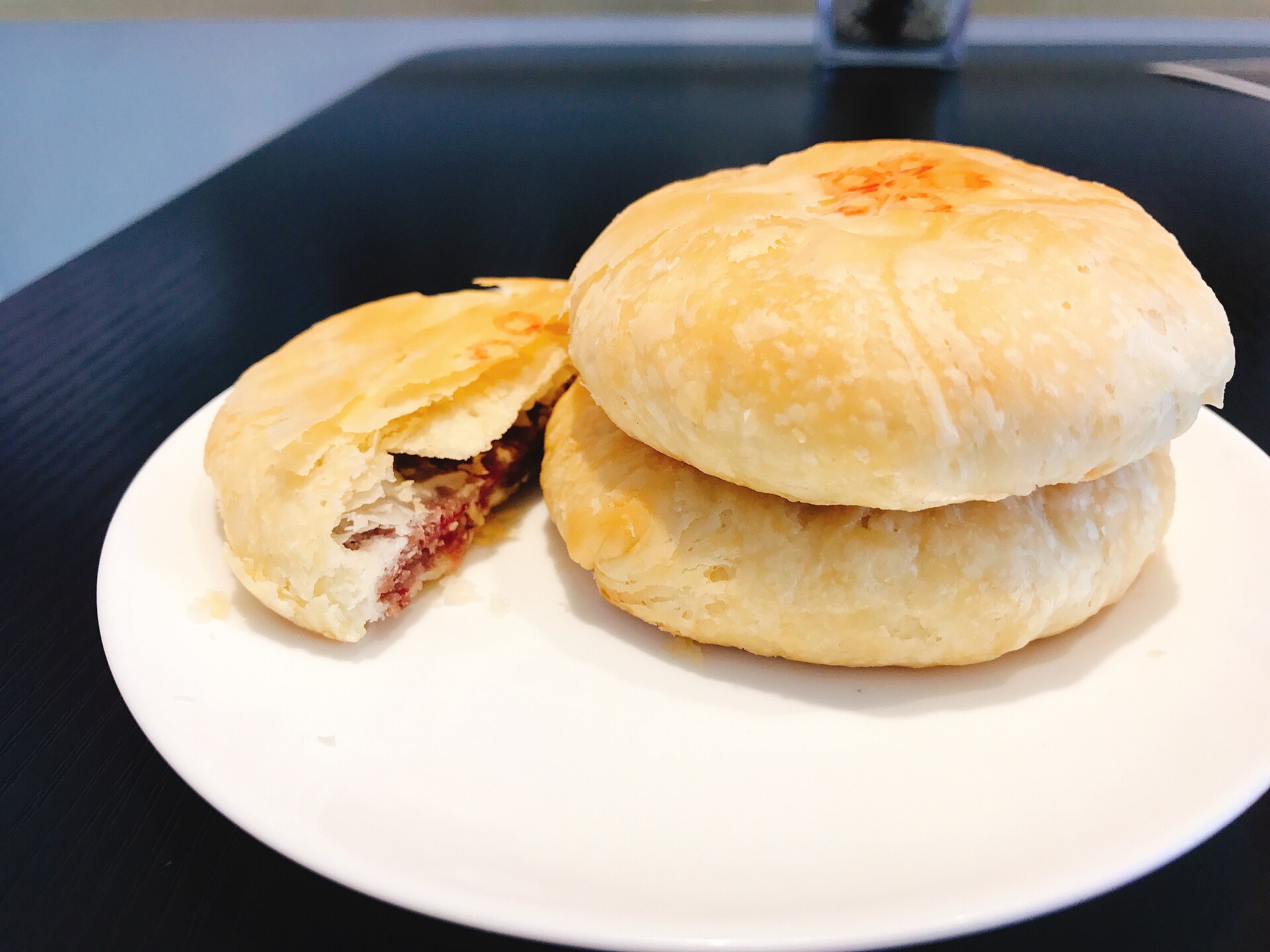
In the summer heat of Kunming, the capital of China's Yunnan Province, the air carries something unusual for a city of six million: the faint sweetness of roses. They grow on hillsides, spill across market stalls, and find their way, inevitably, into the city's most famous export — a small, flaky pastry stuffed with rose petal jam that locals call xiānhuā bǐng (鲜花饼), or fresh flower cake.
This July, Prof. Seung-chul Yoo of Ewha Womans University's Department of Communication and Media Studies led fourteen undergraduate and graduate students on a field research program to Kunming and Lijiang — not as tourists, but as observers of what he calls urban communication: the idea that cities speak not through slogans or advertising campaigns, but through the textures of their streets, the smells of their markets, and the objects people carry home.
Prof. Seung-chul Yoo and fourteen students listen to a briefing at Jiahua Food's Kunming headquarters. Photo: Seung-chul Yoo
A Brand Built on Terroir
The centerpiece of the visit was Jiahua Food (嘉华食品), a company founded in Kunming in 1994 that transformed a regional delicacy into Yunnan's most recognizable souvenir. The rose flower cake — buttery, fragrant, and sold in elegantly packaged gift boxes — now moves through airports, high-speed rail stations, and e-commerce platforms across China. Yet the product's power, Prof. Yoo argues, derives precisely from its rootedness in a place.
"This is terroir branding," he explained to his students during the visit. "The rose grows here because of Yunnan's altitude, its mild climate, its particular soil. The brand doesn't just sell a pastry — it sells the credibility of a geography." The concept, borrowed from the wine world's vocabulary, describes how natural conditions and local culture become embedded in a product's identity. Jiahua Food has built its entire narrative around this logic: the flower, the land, the city.
Jiahua Food's signature rose flower cake (鲜花饼), the product that turned a regional ingredient into a national gift. Photo: Seung-chul Yoo
When Tourists Become the Medium
What makes the Jiahua case particularly instructive for communication scholars is the mechanism by which the brand travels. No television campaign or influencer contract is required. The tourist buys a box, photographs it against the backdrop of Kunming's flower markets, posts the image to WeChat or Xiaohongshu, and then carries the box home to Beijing or Seoul or Tokyo, where the gift becomes a story about a city. The consumer, in this model, is not the audience — they are the medium.
Prof. Yoo frames this as a form of user-generated content (UGC) that is structurally embedded in the product's design. "The packaging is beautiful because it needs to be photographed. The flavor is distinctive because it needs to be remembered. The gift-giving ritual is encouraged because it extends the brand's reach without any additional marketing spend." In the language of communication theory, the message is encoded not in an advertisement but in the object itself and the social behaviors it triggers.
JUST HOT, Jiahua Food's café and experiential retail brand, extends the rose flower cake narrative into a full urban lifestyle concept. Photo: Seung-chul Yoo
The Danger of Going Everywhere
The visit also raised a question that Jiahua's leadership acknowledged with candor: what happens to a terroir brand when it leaves its terroir? As the company has expanded to e-commerce platforms and retail outlets across China, the rose flower cake has become available in cities where no one has ever seen a Yunnan rose field. The product travels; the geography does not.
Prof. Yoo sees this as the central tension in regional branding. "The moment you can buy it anywhere, you lose the reason to go there," he told his students. "But if you refuse to scale, you remain a local secret." The resolution, he suggests, lies in ensuring that the story — the terroir narrative — travels with the product even when the product leaves its origin. Packaging, retail design, and digital content must continuously reinforce the geographic imagination that gives the brand its meaning.
The Ewha research team in Kunming. Fourteen students participated in the field program alongside Prof. Yoo. Photo: Seung-chul Yoo
From Kunming to Lijiang: Reading a City Through Its Senses
The program continued in Lijiang, the ancient town in northwestern Yunnan where the Naxi people have maintained a distinct language, musical tradition, and visual culture for centuries. Here the urban communication lesson shifted register: from commercial branding to the slower, deeper work of cultural preservation as place identity.
Students participated in sessions on Naxi script — one of the world's few remaining pictographic writing systems still in active use — and observed how the town's architecture, craft markets, and ceremonial practices constitute a form of ongoing communication about who the Naxi are and why Lijiang is irreplaceable. "A city that has a story it cannot stop telling," Prof. Yoo observed, "is a city that will always have visitors."
In Lijiang, the team engaged with Naxi cultural practitioners, exploring how indigenous language and tradition function as urban communication. Photo: Seung-chul Yoo
What Korean Cities Might Learn
For the Korean students in the group, the Yunnan program offered an oblique mirror. South Korea has its own regional food brands — Jeju tangerines, Gochang bokbunja wine, Nonsan strawberries — but the communication infrastructure around them remains, in Prof. Yoo's assessment, underdeveloped. "We produce the product. We don't always produce the story," he said. "Jiahua didn't just make a good pastry. They made a reason to go to Kunming."
Baek Jin-young, a graduate researcher on the trip, put it more directly: "The city's image is built not through promotional slogans but through the spaces and the behaviors of the people in them." Her colleague Jin Myung-won added: "Korean regional specialties also need to design the producer, the space, the consumer experience, and the digital content together — as a single system."
The rose flower cake, in the end, is a small object carrying a large argument: that place-based identity, when carefully constructed and consistently communicated, can become a brand more durable than any campaign. Kunming does not need to advertise itself. It has a pastry that does the work.
Originally published in Korean in MAD Times (July 21, 2026). Adapted and expanded for Seoul Signals by the author.