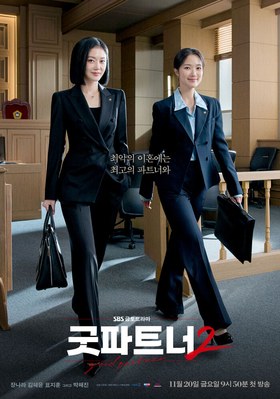
Two women in dark trouser suits walk out of a courtroom, carrying black work bags. Neither is pictured waiting for a man to resolve the crisis. In SBS’s main poster for Good Partner 2, Jang Na-ra and Kim Hye-yoon occupy the frame together. The translated slogan reads, “For the worst divorces, with the best partner.” It is a compact statement of the sequel’s proposition: a marriage may fail, but a working relationship can help someone move forward.
A launch-week signal, not a global verdict
That pairing now has a measurable domestic attention signal. In RACOI’s TV drama cast ranking for November 16–22, 2026, Jang Na-ra placed first with 4,921 mentions and Kim Hye-yoon second with 4,608. Their co-star Park Hae-jin ranked fifth with 3,405. The week includes the sequel’s November 20 premiere, so it captures the launch period rather than an established season-long response.
The category matters: this is the TV ranking, not a combined TV-and-OTT table. RACOI’s methodology tracks weekly internet reaction. These mention totals are not unique viewers, favourable sentiment or television ratings, and they say nothing directly about American audiences. They establish that the cast attracted discussion. They do not establish why every mention occurred, or whether overseas viewers will stay.
This partner arrives with experience
The 2026 production is not a relabelled introduction to the 2024 series. Jang returns as Cha Eun-kyung, now running her own divorce-law firm. Kim plays Kang Hye-seong, a fifth-year associate. SBS’s official premise explicitly pairs a managing lawyer with an experienced hire. Writer Choi Yu-na, herself a divorce lawyer, returns to the script.
The distinction changes the professional relationship. Season one paired Eun-kyung with Nam Ji-hyun’s idealistic newcomer Han Yu-ri. In his November 24 review for the South China Morning Post, critic Pierce Conran argues that Hye-seong’s professionalism and less naive moral outlook make her feel more like Eun-kyung’s equal. That is a critical assessment, not a claim that the ranking proves viewers prefer experienced women. But it identifies a stronger dramatic question than whether a beginner can keep up: can two capable lawyers respect each other without agreeing?
The courtroom is also a workplace
Professional authority does not end when the hearing does. The sequel gives Eun-kyung a business to run, a team to build and a competitor close enough to occupy the floor above her. Soompi’s November 5 preview describes rival firms on the seventh and eighth floors of the same building, both trying to recruit Hye-seong. Park Hae-jin’s Park Tae-su is therefore not simply another face in the cast: he challenges Eun-kyung’s position as an employer.
That is useful material for a cross-border workplace story. Hiring, competition and the difficulty of trusting a colleague are legible without prior knowledge of Korean divorce procedure. The poster reinforces this emphasis. Its bags, suits and shared stride present the women as practitioners heading through a working day, not as decorative companions to a male legal genius. Their partnership is the product being advertised.
What survives translation
SBS calls the programme a saida divorce show. The term borrows the refreshment of a fizzy drink to describe satisfying relief from frustration; DongA Science’s explanation of the slang describes words or situations that express pent-up feelings clearly. Here, it signals the catharsis the broadcaster promises, not a finding about audience sentiment.
That promise can travel more readily than a particular legal rule. A client wants a way out; a lawyer must decide what a workable outcome looks like. For American readers accustomed to their own courtroom conventions, and for readers elsewhere in Europe, the point is not to assume Korean proceedings work identically. It is to follow how competence and responsibility are dramatised within this setting. Choi’s professional background makes the premise distinctive, but fiction remains fiction, not a guide to anyone’s divorce.
A listing is not a worldwide licence
The practical route is more specific than “watch it globally.” Viki’s official sequel page identifies the 2026 title, lists English and other subtitles, and marks episodes as Viki Pass. US readers can check that exact listing in their location, but the public page reviewed for this article does not establish US licensing. A listing should not be presented as a regional viewing guarantee.
Singapore has clearer territory-specific evidence: Viu Singapore’s official promotion advertises Good Partner 2 from November 20. That verifies an offer, not local popularity. The broader media lesson is modest but important. Domestic attention gives a title a reason to be noticed; a recognisable professional relationship gives it a reason to be understood. Neither replaces accessible, accurately described distribution. The sequel’s international opportunity lies in that combination—not in turning a Korean mention count into a claim of global conquest.
Sources & Notes
RACOI TV drama cast ranking, November 16–22, 2026, and its methodology; SBS programme introduction and October 30 poster release; Soompi, November 5; Pierce Conran, South China Morning Post, November 24; official Viki listing and Viu Singapore promotion, checked November 26. DongA Science’s October 23, 2015 slang explanation supplies cultural context only. Assessment as of November 26, 2026. The poster is rights-reserved, not openly licensed; SBS Star’s terms do not grant general commercial republication permission. TV drama cast internet-reaction ranking, November 16–22, 2026. RACOI internet-reaction measurement methodology.