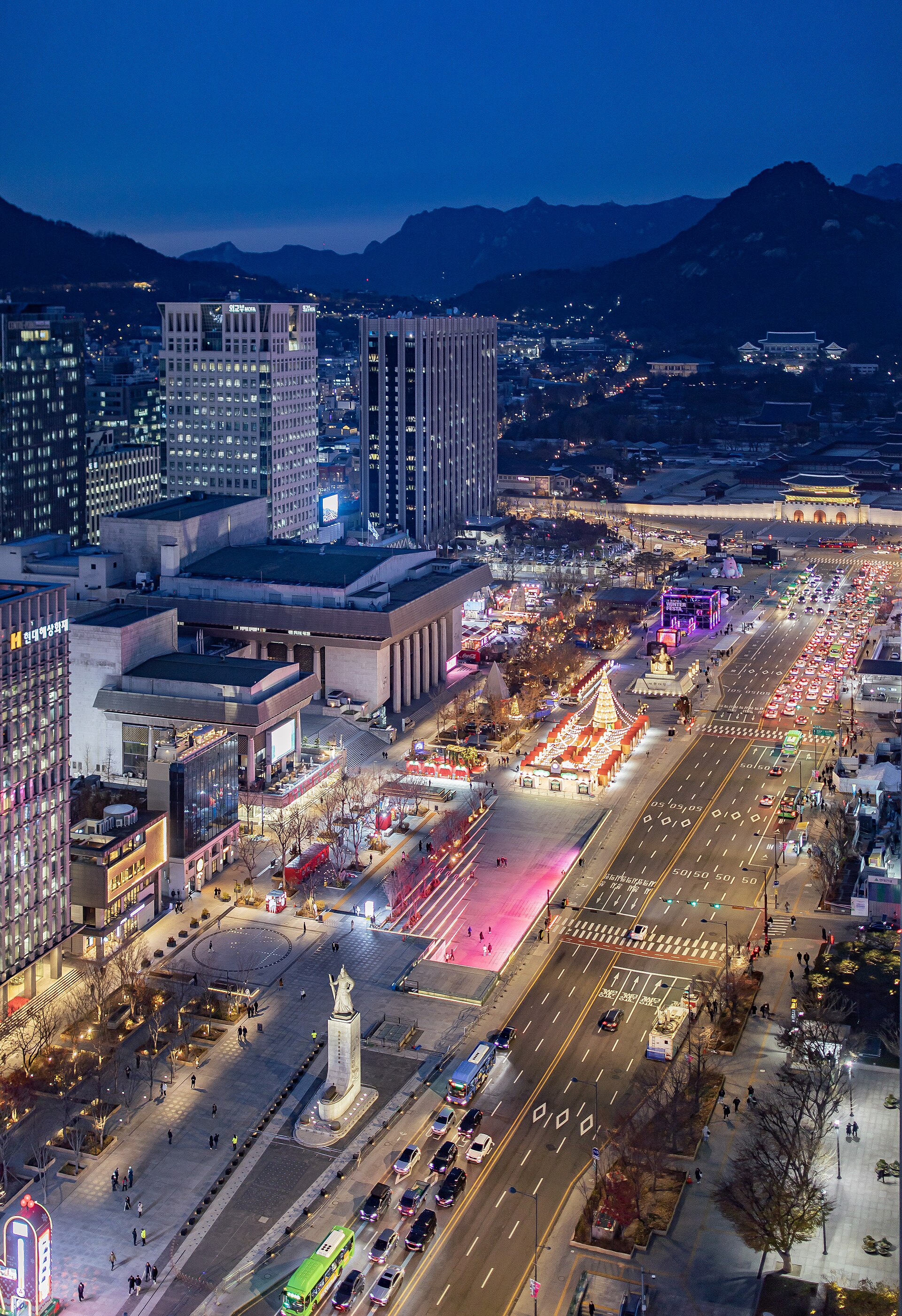
Gwanghwamun (광화문), Seoul's symbolic civic heart, is undergoing a transformation that raises profound questions about how cities communicate with the world. In 2025, digital light began to appear across this historic space — not merely as commercial billboards, but as light cast across the axis of Gyeongbokgung Palace (경복궁), along the ceremonial line of Sejong-daero (세종대로), before the statues of King Sejong (세종대왕) and Admiral Yi Sun-sin (이순신 장군).
The debate surrounding the Gwanghwamun Outdoor Advertising Free Display Zone (광화문 옥외광고물 자유표시구역) could never be only about advertising. It is, at its core, a question of how Seoul chooses to show its face to the world. It is also a question of whether a global city can hold together two impulses that often collide: commercial expression (상업적 표현) and civic dignity (공공적 품격).
The Global Rise of Digital Out-of-Home Advertising
The global market for digital out-of-home advertising (디지털 옥외광고) is expanding rapidly. According to Grand View Research, the worldwide digital out-of-home advertising market is projected to grow from roughly $20.7 billion in 2024 to about $39.1 billion by 2030. But numbers alone do not guarantee the success of urban media. The growth of digital signage does not simply mean that cities will have more screens. It means that walls, plazas, pedestrian routes and public facades are becoming increasingly mediatized.
The city is no longer a passive backdrop onto which advertising is attached. It is becoming an integrated communication environment (통합 커뮤니케이션 환경) in which advertising, mobility, architecture, tourism and public memory operate together.
Gwanghwamun is where this transformation becomes especially sensitive. The giant screens of COEX in Gangnam move naturally within the rhythm of commerce and entertainment. But screens in Gwanghwamun are projected onto something else: history, state symbolism, civic memory (시민의 기억) and the ritual dignity of public space. The same screen that may feel playful in a shopping district must become a more careful sentence in Gwanghwamun.
Understanding Citizen Perception: The Lee and Yoo Study
A recent study by Lee and Yoo, published in Advertising Research (광고연구) in 2026, examined 400 adults from Seoul and the metropolitan area who had visited the Gwanghwamun Outdoor Advertising Free Display Zone within the previous six months. The study found that contextual congruity between place and medium (장소-매체 맥락 일치성), as well as advertising informativeness (광고 정보성), positively influenced citizens' perceptions of urban vitality (도시 활력) and public value (공공가치). By contrast, advertising irritation negatively affected purchase intention, while sensitivity to light pollution (빛공해 민감도) shaped some response pathways differently.
The importance of this research lies in its reframing of digital advertising in Gwanghwamun. It moves the discussion away from a narrow question of media effectiveness and toward a broader question of urban experience (도시 경험), public value and civic acceptance.
Gwanghwamun Square: From Consultation to Governance
The formal launch of Gwanghwamun Square (광화문스퀘어) pushes this discussion into a new phase. According to reports, Jongno District held the founding general meeting of the incorporated association "Gwanghwamun Square" in April 2026, transforming the previous public-private consultative body (민관협의체) into an official organization. The plan envisions roughly 221,815 square meters around Gwanghwamun Square and Sejong-daero as a vast media-art canvas (미디어아트 캔버스).
This is not simply a project to install more electronic billboards. It is closer to a declaration that the building facades, plaza, pedestrian flows, cultural institutions and tourist routes of Gwanghwamun will be organized as one urban media platform (도시 미디어 플랫폼).
The essence of urban media is not hardware but governance (거버넌스). A screen is hardware. But deciding what content appears, when it appears, how one building's screen relates to another, and how the media environment connects with museums, restaurants, bookstores, pedestrian routes and public safety — all of this belongs to the realm of operating philosophy (운영 철학).
The BTS Performance: A Model for Urban Media Coordination
The BTS performance at Gwanghwamun on March 21, 2026, offered a symbolic glimpse of what such a system might become. According to reports, BTS's Gwanghwamun comeback performance was livestreamed through Netflix to more than 190 countries and regions, and it was introduced as the first solo artist performance held at Gwanghwamun Square. Jongno District stated that major digital billboards in the Gwanghwamun Square Outdoor Advertising Free Display Zone were linked to create a large-scale media stage.
Screens on major buildings — including KT WEST, the Koreana Hotel, The Dong-A Ilbo and Sekwang Building — were connected. Before the performance, a special film featuring Gyeongbokgung Palace was transmitted across multiple media surfaces. The scene showed that individual displays could become a single urban stage (도시 무대).
What mattered was not only the star power of BTS. The performance worked because several forces came together: Gwanghwamun as place, Gyeongbokgung as historical background, the global circulation of K-culture (K-컬처), the technical synchronization of digital signage and the coordinating capacity of a public-private governance structure.
The screens did not overwhelm the city. Rather, the city disciplined the screens into becoming part of its stage. That is the direction Gwanghwamun Square must follow.
Public Value as Foundation, Not Compliance
Artificial light in the city is always double-edged. Well-designed light creates safety, vitality, festivity and memory. Light without reason creates fatigue, irritation and resistance. This is why public value (공공가치) is not a decorative concern in Gwanghwamun. It is central to the legitimacy of the entire project.
According to Lee and Yoo's 2026 study, when citizens perceive digital billboards as publicly useful, they are more likely to show positive responses to advertising and a stronger intention to revisit the place. In other words, publicness (공공성) is not a cost that weakens advertising effectiveness. It is a foundation that can increase advertising acceptance.
The advertising industry often treats public value as a compliance requirement. A certain percentage of public service messages must be shown. Brightness rules must be followed. Administrative information must occasionally be transmitted. But in Gwanghwamun, publicness cannot remain a defensive device. It must become the persuasive core of the space.
When citizens feel that a screen helps them move through the city, that its light enhances rather than damages the dignity of the place, and that its content enriches Gwanghwamun, the billboard stops being an obstruction. It becomes an urban media service (도시 미디어 서비스).
Learning from Japan: Place Memory Over Spectacle
Japan offers useful clues for Gwanghwamun Square. Osaka's Dotonbori Glico Sign (도톤보리 글리코 사인) was originally an outdoor advertisement for a confectionery brand. Today, it is an urban icon representing Dotonbori itself. The sign was first installed in 1935, and the current sixth-generation sign was installed in 2014, measuring 20 meters high and 10.38 meters wide, and using approximately 140,000 LED chips. It is a case in which advertising, over time, has been absorbed into the photographic rituals and tourist memory of a place.
Tokyo's Shinjuku East Exit Cat (신주쿠 동쪽 출구 고양이) offers another model. The content used 3-D illusion technology on Cross Shinjuku Vision, but it was designed not merely as a spectacular advertisement. It was staged as if a character lived inside the building. The cat wakes in the morning, appears throughout the day and goes to sleep at night. In doing so, it connects with the temporal rhythm of the city.
But Gwanghwamun is not Dotonbori, Shinjuku or Shibuya. Dotonbori is a district of commercial pleasure and food culture. Shinjuku is well suited to characters, spectacle and urban entertainment. Shibuya symbolizes youth culture and pedestrian density. Gwanghwamun is a place of national symbolism (국가 상징) and civic assembly (시민 광장).
Therefore, what Gwanghwamun should learn from Japan is not form but principle. Advertising becomes place memory (장소 기억) only when it understands the character of the place deeply.
Light Pollution Sensitivity: The New Performance Metric
As Gwanghwamun Square grows, the most delicate issue will be light. In 2026, Seoul introduced the country's first daytime brightness guideline for electronic billboards, setting the daytime standard at 7,000 cd/㎡ or below and subdividing nighttime standards according to display area and time period. After inspecting 200 outdoor electronic billboards of 30 square meters or larger managed by the Seoul Metropolitan Government, the city found that 158 were adjusting brightness through automatic luminance control systems or similar devices.
The future competitiveness of digital signage will not lie in the ability to shine brighter. It will lie in the ability to shine only as much as necessary. Digital signage is an adjustable medium (조절 가능한 매체). Policy, therefore, should also evolve from fixed regulation toward responsive operation (반응형 운영).
Lee and Yoo's 2026 study suggests that sensitivity to light pollution affects how citizens interpret the same digital advertisement. Citizens less sensitive to light are more likely to interpret an advertisement as having public value when it fits the place. For citizens highly sensitive to light, however, the physical stimulus of the screen may precede any judgment about content harmony.
Yet the study also points to an important nuance. Citizens more sensitive to light may respond strongly to the usefulness of information. Even uncomfortable light can become more acceptable when citizens understand why it is necessary.
Gwanghwamun Square, therefore, should not ask only, "How many people saw it?" It must also ask, "How many people accepted it without discomfort?"
Gwanghwamun Must Remain Gwanghwamun
The transformation of the previous public-private consultative body into the incorporated association Gwanghwamun Square is significant from a public-interest perspective. A free display zone does not become beautiful simply because regulation is relaxed. On the contrary, the greater the freedom, the greater the responsibility for coordination.
An operating structure is needed to decide what content appears and when, how public information and commercial advertising are balanced, how safety guidance and screen direction are integrated during major events, how brightness is coordinated with adjacent neighborhoods, and how screen synchronization between buildings is reviewed.
Gwanghwamun Square cannot be managed through ordinary advertising review alone. Urban design, lighting, pedestrian safety, media art, public communication and tourism routes must be considered together.
Many cities dream of becoming Times Square. But not every city needs to become Times Square. Gwanghwamun should not become Times Square. Gwanghwamun must remain Gwanghwamun.
Its competitive advantage does not lie merely in large screens. It lies in the rare convergence of history, publicness, civic memory and the living present of K-culture. For Gwanghwamun Square to become a model of Korean-style urban communication (한국형 어반 커뮤니케이션), advertising must not be a light that covers the city. It must become a language that gives the city meaning.
References
Grand View Research. (2025). Digital out-of-home advertising market size, share & trends analysis report, 2025–2030.
Guinness World Records. (n.d.). Busiest pedestrian crossing: Shibuya Crossing.
Japan Media Arts Festival. (n.d.). Giant 3D Cat. Agency for Cultural Affairs, Government of Japan.
Yoo, S.-C. (2026, March 7). When BTS sings Arirang at Gwanghwamun, Seoul becomes a stage for a nation—and a planet. Seoul Signals.
Ezaki Glico. (n.d.). Dotonbori Glico Sign.
D'Live News. (2026). Gwanghwamun transforms into a "media art city": Gwanghwamun Square officially launched [YouTube video].
Seoul Metropolitan Government. (2026). Press release on recommended daytime and nighttime brightness standards for outdoor electronic billboards.
Asia Economy. (2026, April 29). "Gwanghwamun as a global media-art hub": Jongno District launches incorporated association Gwanghwamun Square.
Lee, S.-J., & Yoo, S.-C. (2026). Contextual congruity and informativeness effects of advertisements in the Gwanghwamun Outdoor Advertising Free Display Zone: Focusing on multi-group analysis by light-pollution sensitivity. Advertising Research, 148, 36–83.