The Island the Movie Made Visible
Silmido, Film Tourism, and the Uneasy Afterlife of a Korean Beach
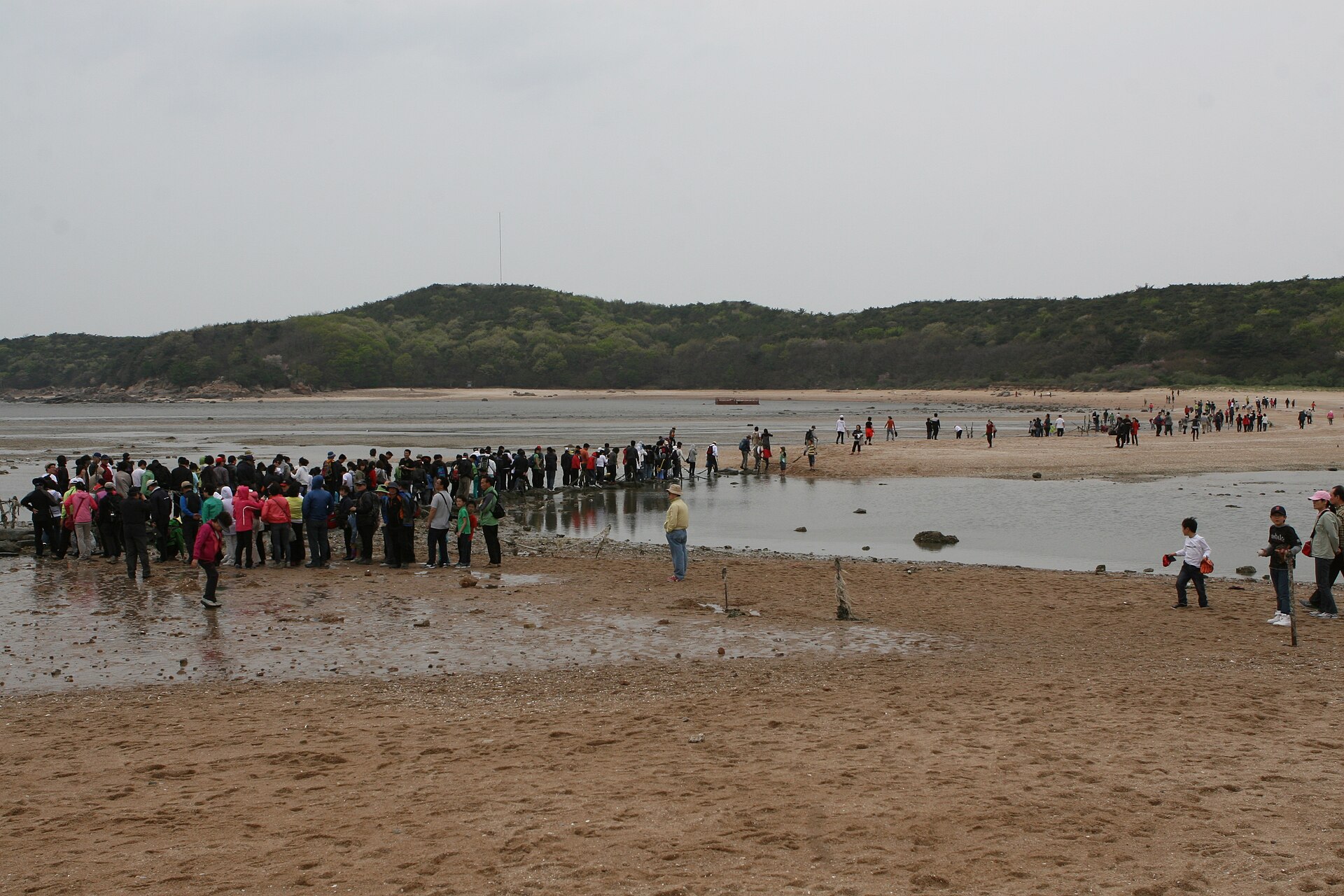
At low tide, the sea retreats from the edge of Muuido Island (무의도), and Silmido (실미도) briefly stops being an island. A path appears across the tidal flat (갯벌), and visitors walk toward the shore as if entering a scene already written for them. There are cars, tents, children, pine trees, and the weekend ease of a recreation area. Yet the name on the map does not belong only to leisure. It belongs to a film.
For most Koreans, Silmido first arrived not as geography but as cinema. Kang Woo-suk's 2003 film Silmido (실미도) became the first Korean film to draw more than 10 million admissions, a milestone that marked the arrival of Korea's blockbuster age and the public return of a story long buried under secrecy. A Korean academic study describes the film's mass appeal as rooted in its reality-based narrative and its transformation of a hidden national tragedy into popular cinematic form.

That is why Silmido Recreation Area (실미도 유원지) should not be understood merely as a beach attached to a famous movie. It is more complicated than that. It is a place where film tourism (영화 관광), dark tourism (다크 투어리즘), Cold War memory (냉전 기억), and coastal leisure collide. The movie made the island visible; the recreation area now determines whether that visibility becomes memory or merely scenery.
When Cinema Reopened a Closed Archive
The historical event behind Silmido concerns Unit 684 (684부대), a secret South Korean commando unit formed after the 1968 Blue House raid. According to the Encyclopedia of Korean Culture, the unit was created in 1968 for a retaliatory infiltration mission against North Korea; on August 23, 1971, 24 operatives killed 18 guards, escaped from Silmido, and entered Seoul, where subsequent clashes left 28 people dead. Four surviving operatives were later executed in 1972.
These numbers are not background details. They are the moral architecture of the film. Silmido is not merely a military action drama, nor simply a Korean variation on the men-on-a-mission genre. It is a cinematic exhumation of state violence (국가폭력), abandonment, secrecy, and the unresolved cost of division (분단). Its power came from forcing audiences to confront a story that had existed at the margins of official memory.
The film's 10-million-admission achievement therefore matters beyond box office history. It was a collective act of belated witnessing. A film theater became, for a time, a civic chamber. Viewers did not simply consume spectacle; they encountered an uncomfortable question: what happens when a state creates men for a mission, erases their names, and later asks the nation to forget them?
The Beach as the Film's Remaining Screen
Today, Silmido is promoted as both a coastal destination and a film-related site. Incheon Jung-gu's English tourism information describes the island as a painful historical site connected to anti-North Korean operative training in the 1960s, and notes that it served as an actual filming location for Silmido. It also explains that the film set has been demolished, leaving visitors with the seaside landscape rather than a preserved cinematic ruin.
This absence is crucial. Many film-tourism destinations rely on material traces: houses, cafés, costumes, reconstructed streets, or museum-like sets. Silmido offers something more unstable. The set is gone, but the name remains. The beach becomes the screen. The tidal road (바닷길) becomes the transition shot. The visitor supplies the montage.

Yet this is precisely where the site becomes ethically fragile. Without careful interpretation, the island risks becoming a picturesque backdrop for a history it does not fully explain. A visitor may remember the movie title but not Unit 684. Another may cross the tidal flat for photographs without encountering the political violence that made the place famous. Tourism can preserve memory, but it can also soften it until tragedy becomes atmosphere.
The Movie Made the Island Famous; Infrastructure Made It Easy
The transformation of Silmido did not happen through cinema alone. Infrastructure completed what the movie began. VisitKorea notes that Muuido became more accessible after the opening of Muuidaegyo Bridge (무의대교), allowing vehicles to reach the island and making nearby destinations, including Silmido and Somuuido, easier to visit.
A bridge does more than shorten distance. It changes the cultural meaning of a place. Before the bridge, an island required waiting, crossing, timing, and inconvenience. After the bridge, it entered the metropolitan weekend circuit. The city could now drive directly toward the memory of the film.
This created Silmido's second life. The movie made it legible; the bridge made it consumable. The result is a hybrid landscape: part film location (영화 촬영지), part tidal attraction, part beach campsite, part historical wound. Such hybridity is powerful, but it requires careful urban communication (어반 커뮤니케이션). Otherwise, convenience flattens memory. The easier a place becomes to reach, the easier it becomes to consume without reflection.
A Film Location That Should Not Become a Theme Park
Silmido should not become a theme park. It should not turn Unit 684 into spectacle or tragedy into entertainment. But neither should it remain an under-interpreted beach where the film's title floats above the landscape without adequate explanation.
A more responsible Silmido would begin with the movie because the movie is how most visitors entered the story. At the entrance, the site should identify Silmido as Korea's first 10-million-admission film and explain why that mattered. Near the tidal path, it should provide a concise historical chronology: the 1968 Blue House raid, the creation of Unit 684, the 1971 escape and deaths, the 1972 executions, the 2003 film, and the later movement toward official acknowledgment.
That last point is not symbolic. In 2024, Yonhap reported that South Korea's defense minister issued a first official apology over the fate of the Silmido unit, during a ceremony marking the beginning of an excavation project for the remains of four executed unit members. The report also noted that the unit had remained relatively unknown before the 2003 film brought it into public attention.
This means the film did not merely dramatize history; it helped reopen the public conditions under which history could be discussed. For that reason, the recreation area should treat Silmido not as a commercial label but as a gateway into public memory (공공 기억).
The Need for Multilingual Memory
Silmido has strong potential as a global cultural-tourism site. It is close to Incheon International Airport, connected to Korean cinema, tied to Cold War history, and embedded in a dramatic coastal ecology. For international visitors, it could become a compact lesson in Korean modernity: division (분단), state secrecy, blockbuster cinema, tidal landscapes, and the uneasy ethics of remembering.
But the site must speak in more than one language. If foreign visitors encounter only scenery, the place fails as cultural communication. English, Chinese, and Japanese interpretation should explain not only where to walk and when the tide returns, but why the island matters. The most important sign at Silmido should not simply say when the sea road opens. It should explain why the island became visible to a nation.
This is where urban communication becomes more than signage. It is the art of arranging place, movement, language, memory, and behavior into a coherent public experience. At Silmido, that means connecting film to fact, scenery to history, tourism to ethics, and leisure to remembrance.
After the Final Shot
The most haunting thing about Silmido today is that the film is everywhere and nowhere. Its title hovers over the beach, but the set has disappeared. The movie made the island famous, but the island has returned to its ordinary rhythms: tide, sand, pine shade, cars, families, and footprints crossing wet flats.
That ordinariness is not a weakness. It is the very condition that makes Silmido so important. Korean cinema (한국영화) did not leave behind a monument. It left behind a question. How should a society visit a place made famous by a film about state violence? How should tourism handle a landscape where leisure and mourning occupy the same shore?
Silmido turned a hidden island into a public symbol. Now Silmido Recreation Area must decide what kind of symbol it wants to be. If it remains only a beach, the film's achievement will shrink into location branding. If it becomes a carefully interpreted coastal archive (해양 기억 아카이브), it can show how cinema, tourism, and public memory may work together without reducing tragedy to spectacle.
The movie made the island visible. The task now is to make that visibility meaningful.